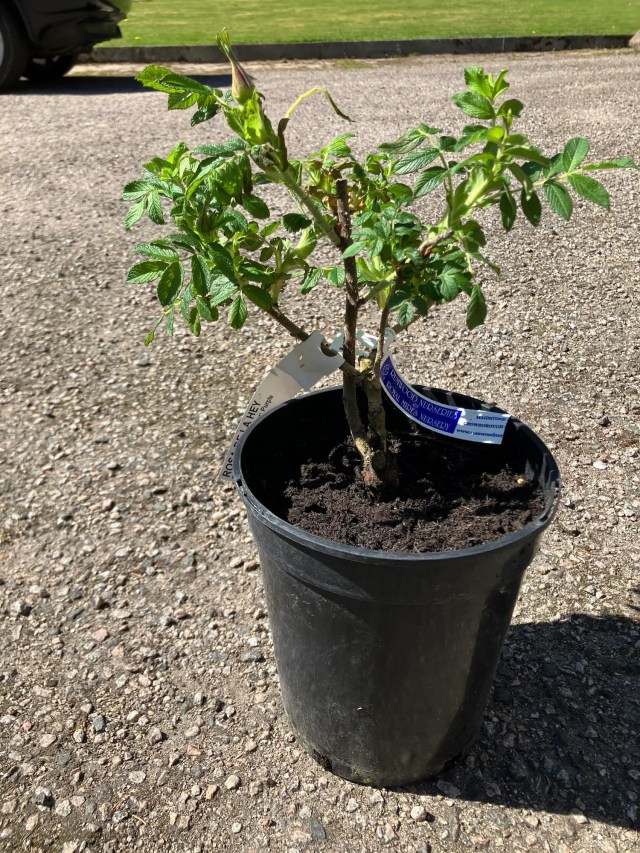
Rosa ‘Roseraie de l’Haÿ’ arrived not with grace, but with grandeur.
Unboxed beneath a rare Aberdeenshire sun, she emerged from her cardboard carriage with the slow disdain of someone well aware of her own myth. Known here simply as Elektra, one word suffices, but her full name commands respect. One bloom. One warning.
If Act I of My Name is Red was the border in its prime—bold, declarative, and upright with conviction—then Act II is the hinge between certainty and doubt. This is not a collapse, but a complication. Not an ending, but a reckoning. And like any good second act, it enters not with a shout, but with a shift—music that leans, tilts, sways. The cello opens the curtain this time, not in triumph but in tension: a low thrum of Piazzolla’s ‘Libertango’, not yet reaching its climax, but already circling something unresolved.
It’s worth noting that ‘Libertango’ is more than just ambience. It is also the melodic seed of Grace Jones’s “I’ve Seen That Face Before”—a song of confrontation, disguise, and memory. Here, too, it becomes a leitmotif. A tango between Rheum and Rose. A dialogue without resolution. And like the border, it asks questions but offers no easy answers.

 THE CULTIVATED STAGE